Dependency graph of Anthropic’s VP ≠ VNP Proof
The mathematics and its Lean 4 formalization are a research artifact released by Anthropic (anthropics/formal-math/vp-vnp; paper.pdf). This page is drawn from the files on the compiled oleans page, which also has the verification checks run on them.
Every declaration used by the five headline theorems of Solution.lean
(mainTheorem, mainTheoremApprox, separation, separationClosure,
and permanent_over_real), directly or through a chain of other declarations, and which of them use which:
4,576 declarations joined by 35,354 links across 320 proof modules. Only 76 declarations in the
compiled development (1.6%) are unused by any of the five theorems and are left out of everything on this page. Below:
the proof as a network, the statistics of dependence and use, a navigator for walking it one declaration at a time, and
a map by folder.
Made possible by the support of Grant 63750, “Explaining Universal Truths”, from the John Templeton Foundation. Additional support from research funds of the Laboratory for Social Minds and from the Survival and Flourishing Fund.
The proof as a network
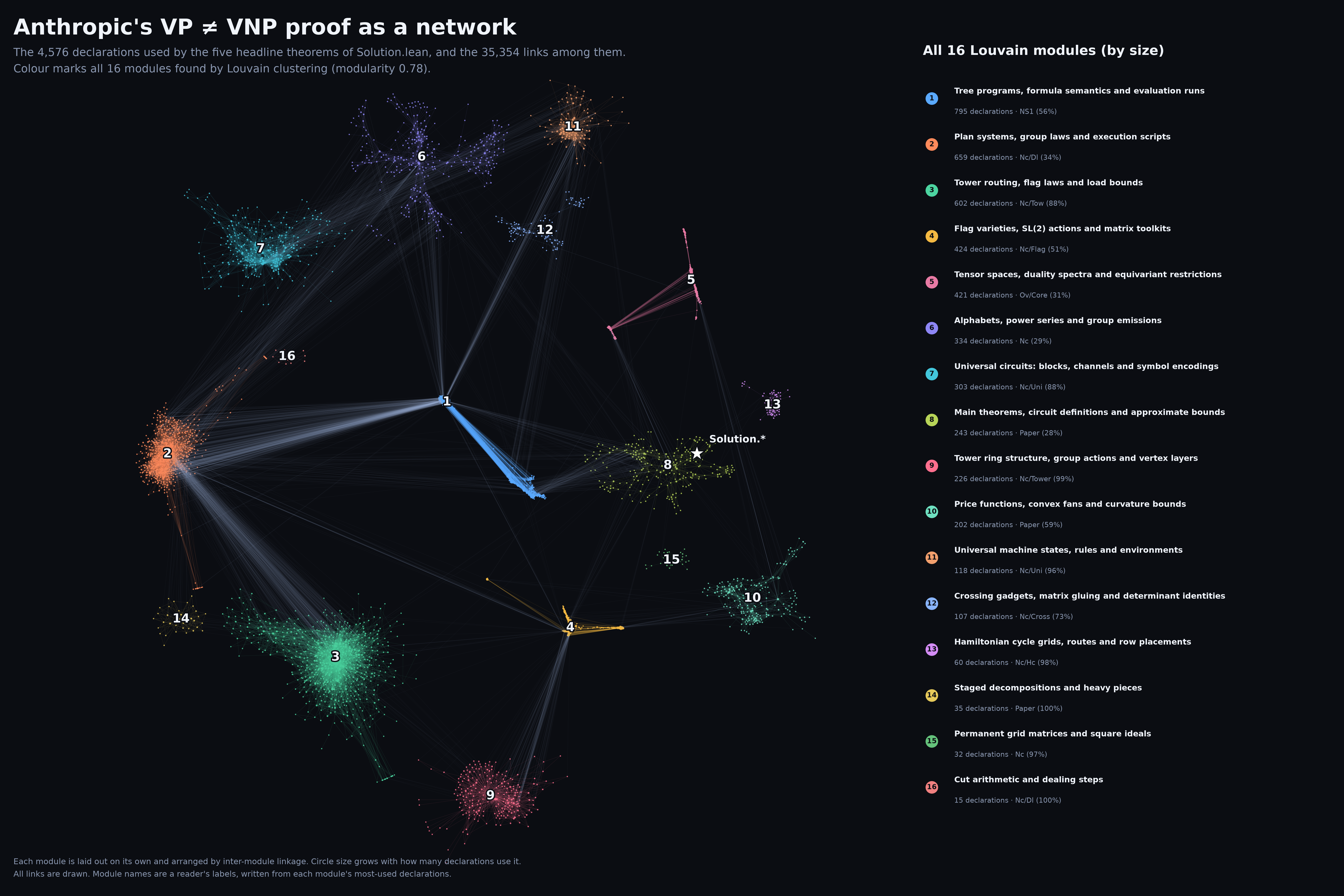
All 4,576 declarations at once. The clusters are the modules that Louvain clustering finds in the links alone, with no knowledge of files or folders: 16 of them (12 with more than a hundred declarations), at a modularity of 0.78. Hover over a cluster for its name and its most-used declarations; select it to keep them in the box and follow them into the navigator.
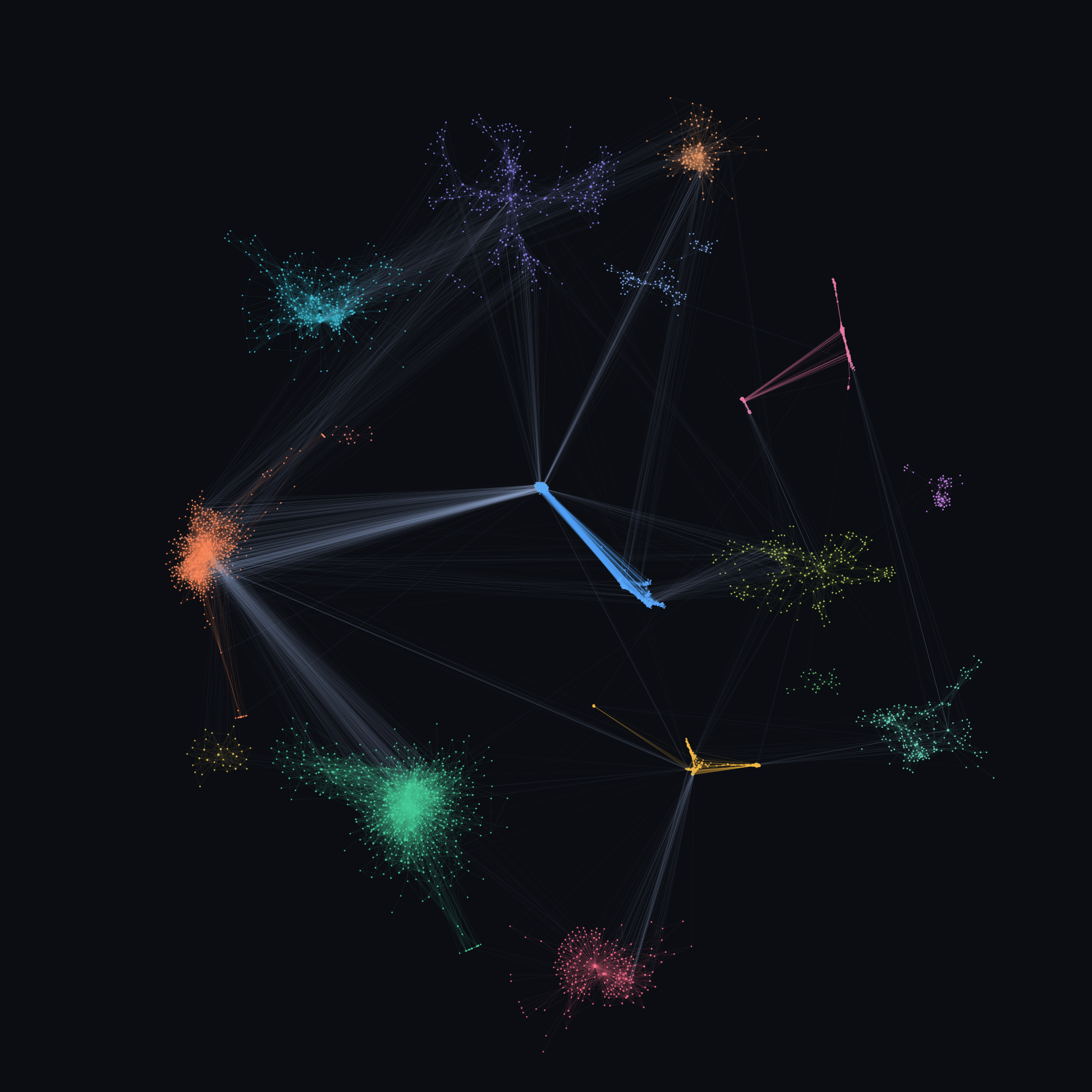
Solution.separationClosure (with the other four headline theorems immediately adjacent).Each module is laid out on its own and the modules are then arranged by how strongly they are linked;
all 4,576 declarations appear in the 16 clusters (none are relegated to an outer ring). Several modules cut across
folders (the largest draws 56% of its declarations from NS1 and the rest from Nc and
Paper), while others align tightly with a single subsystem (such as Nc/Tower at 99% and
Nc/Hc at 98%). The module names are a reader’s labels, written from each cluster’s
most-used declarations, namespaces and distinctive name-words. The proof itself does not name them.
The picture with a key of all 16 modules
is a 6000 × 4000 PNG (6.2 MB).
Dependence and use
Viteri & DeDeo, “Epistemic phase
transitions in mathematical proofs” (Cognition, 2022), count two things for every claim in 48
machine-checked proofs written in Coq: how many claims it depends on, and how many claims use it. Here the same
counts are made on two networks rooted at Solution.separationClosure: the top of the proof,
the 1,123 declarations within 9 steps of the theorem (first depth past 1,000 claims), and the whole proof,
all 4,544 declarations the theorem uses.
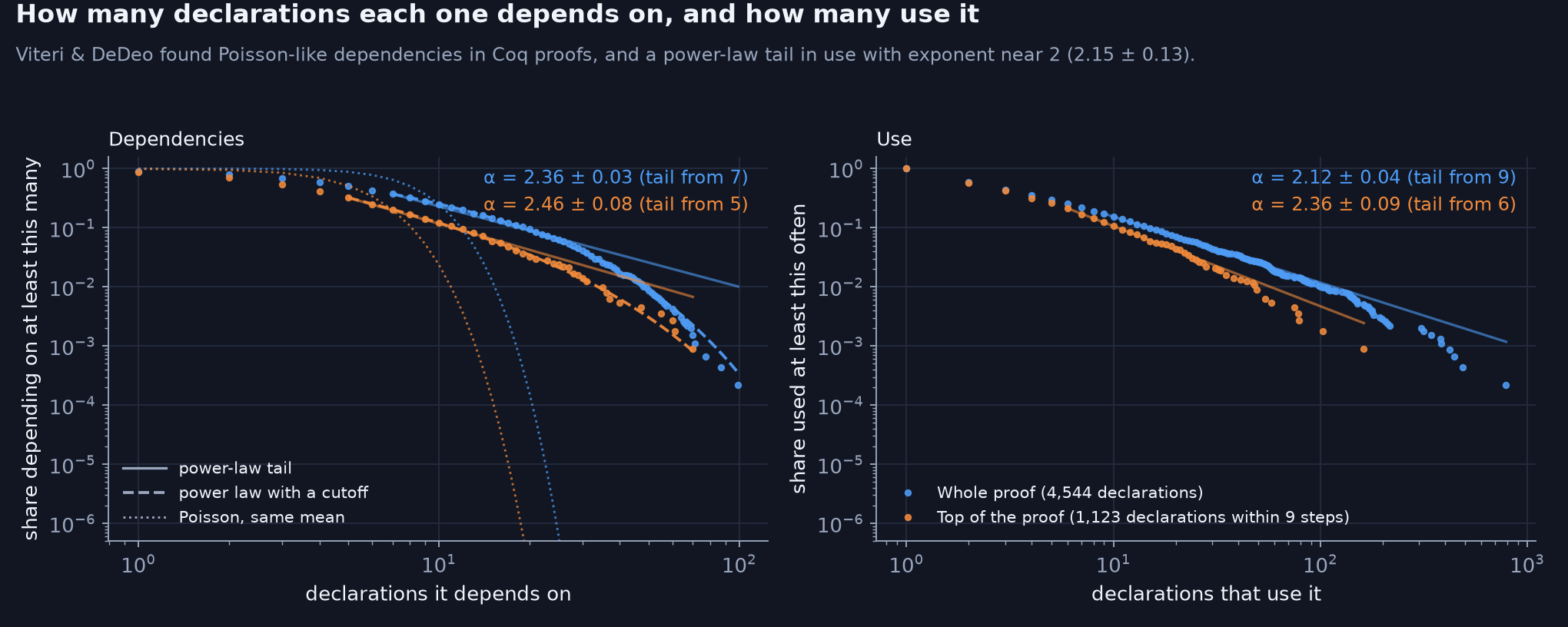
In the paper’s Coq proofs, dependencies are Poisson-like (mean around three) while reuse has a power-law tail with exponent 2.15 ± 0.13. Here the use tail matches: 2.12 ± 0.04 over the whole proof (from 9 users) and 2.36 ± 0.09 at the top (from 6 users), consistent with construction by “tinkering and reuse” (Solé & Valverde, 2019; Krapivsky & Redner, 2005).
Dependence is heavy-tailed too, with a downward bend (mean 7.72, variance 92.2, max 99). A pure power law gives 2.36 ± 0.03 whole (from 7 dependencies) and 2.46 ± 0.08 at the top (from 5), though a power law with an exponential cutoff or a log-normal fits better—as expected when a single Lean declaration can invoke dozens of earlier lemmas.
Compared with the Riemann Hypothesis proof and human Lean proofs, no real tension remains once cutoffs and graph boundaries are matched. On automatic fits, RH looks steeper in dependencies (2.99 vs. 2.36) and flatter in use (1.89 vs. 2.12), largely because automatic fitting picks a higher cutoff on the 175× larger RH graph. At a common cutoff (xmin = 10, unbounded discrete MLE), both proofs track size-matched human Mathlib v4.33.1 theorem closures closely in dependencies (2.59 vs. human median 2.63 at 3k–7k nodes; RH top 2.41 vs. 2.27 at 14k–35k). In reuse at xmin = 10, VP ≠ VNP (2.14) and RH (1.92–2.05) are steeper than internal Mathlib closures (1.77–1.83) mainly because Mathlib retains core library hubs that standalone projects exclude; on the same-toolchain term-level graphs of DeDeo (2026), RH (2.41) and VP ≠ VNP (2.47–2.63) sit squarely inside the human Mathlib range (median 2.43, range 2.25–2.68).
The paper’s model of belief, run on this proof: deduction against abduction, and the effect of the prior
The paper models a reader who goes over a proof step by step, revising belief in each claim to agree with the claims it depends on (deduction) and the claims that depend on it (abduction), with some chance of error at every inference.
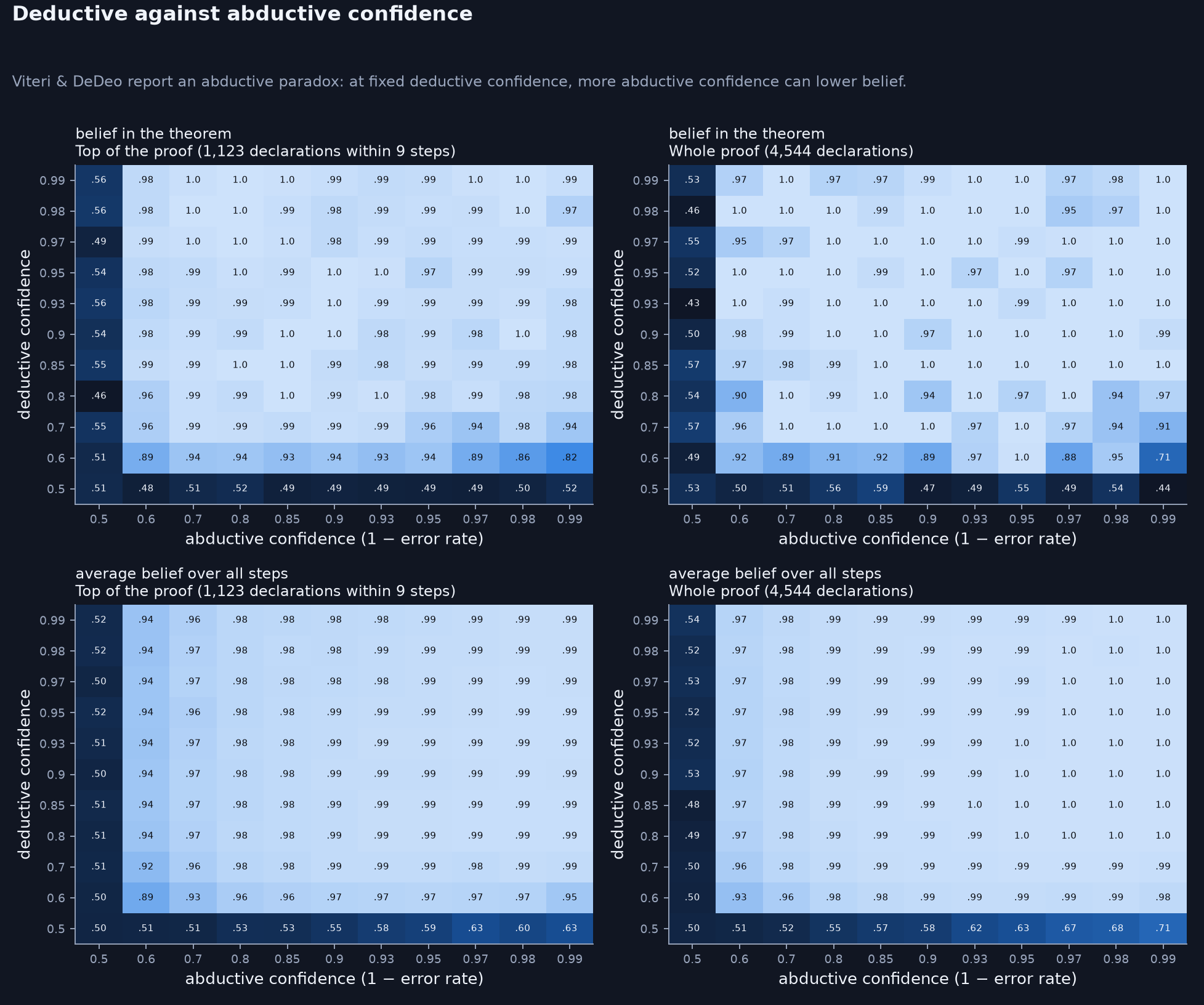
Unlike the Riemann Hypothesis graph—where the final theorem sits at the tip of a thin 1-1-2-3
chain and shows a sharp abductive drop—Solution.separationClosure rests on a much wider immediate
foundation (1, 12, 17, 32, 65 declarations in the first five levels). At a deductive confidence of 0.85, belief in the
theorem on the whole proof remains near 1.00 across high abductive confidences, with only a mild dip on the truncated
network (peaking at 0.998 at abductive confidence 0.85 and edging down to 0.984 at 0.99).
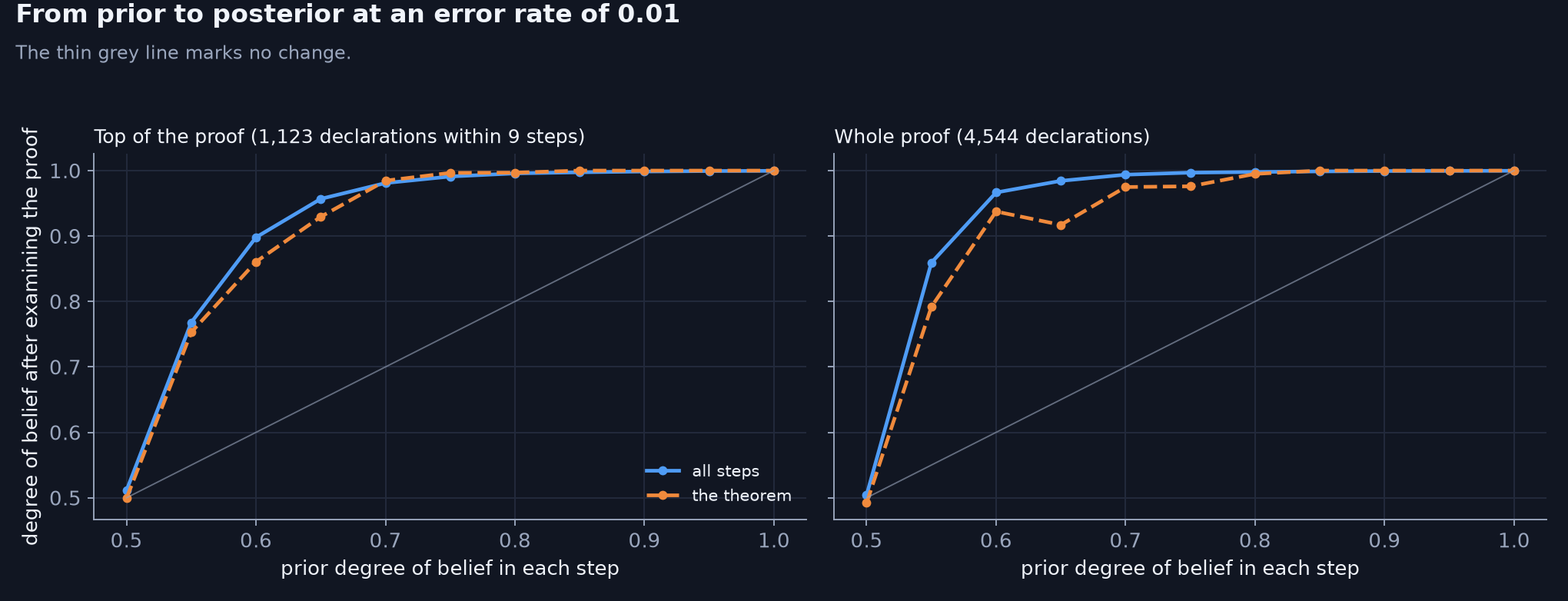
At an error rate of 0.01, a prior of 0.60 in each step already brings belief in the whole proof to 0.97 across all steps and 0.94 for the theorem itself (rising to 0.997 and 0.976 at prior 0.75). Settings follow Viteri & DeDeo (prior 0.75 where not varied; 10 sweeps per declaration; belief averaged over the second half of each run). This is a model of how belief forms; it says nothing about whether the proof is correct.
Walk the graph from any declaration
Type a declaration’s name, or the end of it, and pick it from the list. The drawing shows what uses it on the left and what it uses on the right, as many steps out as you choose. Select any circle to move there. The box beneath gives its signature as written in source and the full lists.
Map of the proof, by folder
Each circle is a folder of the source tree, sized by how many declarations it holds. An arrow from A to B means declarations in A use declarations in B, and its width shows how many such uses there are. Folders nearer the top sit closer to the headline theorems. Select a circle to read its numbers; open it to see the folders inside.
| Folder | Declarations | Mean steps below | Theorems | Uses | Used by |
|---|
The top of the proof, declaration by declaration
The declarations within a few steps of the five headline theorems, left to right by how many steps away they are.
Show the first levels as a table
| Declaration | Steps below | Kind | Declarations beneath | Direct uses |
|---|
How deep the proof goes
The number of declarations at each distance below the five headline theorems, counted along the shortest chain of uses, split by top-level library.
Show as a table
The graph as one file
vp-vnp-declaration-graph-used.json.gz
(139 KB) holds the 4,576 declarations used by the five headline theorems of Solution.lean and the
35,354 links among them. It is one JSON object with a meta block and a nodes array with one
declaration per line:
{"id":4561,"name":"Solution.separationClosure","kind":"theorem","file":"Solution.lean","line":47,
 "steps_below_headline":0,"uses_in_signature":[4575],"uses_in_body":[4563,4541,4572,4574],
 "id_in_full_graph":4637}
SHA-256 b9a3ab6a1fc8851e72f7b6948dd8fc9823047eb0d119de6b7247c538e908683a.
The numbers in the two uses lists are ids of other entries.
id_in_full_graph is the declaration’s id in
vp-vnp-declaration-graph.json.gz
(124 KB, SHA-256 dda41928755d097246b49379a68f9654fad261a3ce65ce8ae0e32eb12f6ccbef),
the graph of all 322 proof modules, which also includes the 76 unused declarations.
.olean files of all 322 proof modules (excluding Challenge.lean), so the links are the ones
the Lean compiler recorded, including uses introduced by tactics, instances and notation. A node is a source declaration;
compiler-generated helpers, structure fields and constructors are folded into the declaration that owns them. Uses of
Mathlib and core Lean (312,122 uses of 5,236 external constants) are not drawn. A link says that one declaration mentions
another; it does not say the mention carries mathematical weight, and verification results live on the
compiled oleans page.